Showing posts with label Duchamp. Show all posts

Sunday, January 29, 2012

Future Plans


In 2014, the readymade turns 100. To celebrate the centennial of Marcel Duchamp's concept, I will curate an exhibition of "new readymades" to open in late Spring of 2014 at the American University's Museum at Katzen Arts Center. I have the able support of my friend and excellent colleague, Jack Rasmussen, Katzen's Director, and you can follow our journey at yet another blog I run, Readymade at 100.

Last weekend I traveled to the Philadelphia Museum of Art and met with a curator from the museum's Department of Modern and Contemporary Art to discuss the possible loan of the museum's Duchamp readymades. PMA, of course, has the largest collection of Duchamp artworks in the U.S. and owns several original readymades. When I say "original," I mean those Duchamp works from the 1914-21 era - the readymade's hey-day.(1)

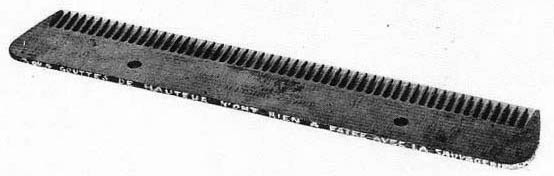
One of those originals, Comb, from 1916, sits unassumingly in a glass vitrine in Room 182 at PMA. Obviously, this is unfathomable to use upon a human and speculation ranges from it being for dogs or cattle.(2)) Its usage is moot because the inscription written in tiny lettering along the edge suggests the more typical Duchampian "use" involving sexual reference.(3)
Regardless, it is an enchantingly diminutive piece that Duchamp felt epitomized the ideal characteristics of a readymade: "No beauty, no ugliness, nothing particularly aesthetic about it."


1. In the 1960's Duchamp would create "replicas" while living in New York City.

2. http://www.toutfait.com/unmaking_the_museum/Comb.html

3. Ibid.

Tuesday, March 22, 2011

Postconceptual Panel Discussion Response to Anonymous

I love the comparisons but Oh no no! For me it has not been wise to choose ANY problem at any time. I multi-task with the best of them but I would get nothing done if I didn’t focus. My focus is deconstructing the everyday things in my life to achieve a new or better understanding instead of coasting and assuming. In choosing a lab, you have chosen the focus of your efforts. Sometimes it is a matter of putting your actions and thoughts on hold for a more fruitful environment. These scientific problems of yours can germinate until you feel comfortable presenting these to your current lab so they become incorporated in their aims or until you have other opportunities. In that way your science is a bit like art. An idea comes to mind but there are so many other things in progress that it cannot be addressed at the time. It is put on hold. (That is what notebooks are for. For me, if it is not written down it can be forgotten but I find the more determined ones resurface. Also, when ideas don’t “drift by” it is high time to wake up and look for them.) By the time the idea is addressed, it has modified and is richer for the aging. (Are you hearing the terms “conceptual” and “malleable”?) You do want results and it doesn’t matter to those looking at the final product how you did it. It matters to you and that is why the final product is successful. Focus does not have to be an exclusive activity but it does require prioritizing tasks. Far from “horrible,” decisions and restrictions become freeing.


Joseph Kosuth

Art After Philosophy (1969) http://www.ubu.com/papers/kosuth_philosophy.html

One and Three Chairs http://www.moma.org/collection/browse_results.php?criteria=O%3AAD%3AE%3A3228&page_number=1&template_id=1&sort_order=1


Sol LeWitt

Sentence on Conceptual Art (1968) http://www.ubu.com/papers/lewitt_sentences.html

Wall Drawing #1113 http://hirshhorn.si.edu/visit/collection_object.asp?key=32&subkey=14893


Duchamp

The Creative Act (1957) http://www.ubu.com/papers/duchamp_creative.html

Bicycle Wheel http://www.moma.org/collection/object.php?object_id=81631


Lucy Lippard

Six Years, The Dematerialization of the Art Object from 1966 to 1972: A cross-Reference Book of Information on Some Esthetic Boundaries. (also @ Amazon)

http://www.specificobject.com/objects/info.cfm?object_id=6495


Martha Rosler

Decoys and Disruptions: Selected Writings, 1975 - 2001 http://www.amazon.com/Decoys-Disruptions-Selected-Writings-1975-2001/dp/0262182319

Semiotics of the Kitchen http://www.moma.org/collection/object.php?object_id=88937